
Garage Door Track Repair: Causes and Fixes
Garage door track repair may involve removing loose debris, correcting alignment, replacing damaged brackets, or installing a compatible track section. Homeowners can safely clean an unobstructed track, but a bent rail, escaped roller, crooked door, loose mount, or cable problem requires professional service. Stop operating the door when it binds or hangs unevenly.
The tracks guide the rollers as each door section moves from vertical to horizontal. Even a localized bend can interrupt that path and transfer stress to rollers, hinges, panels, cables, and the opener. This guide separates safe observation from repairs that belong to a trained technician.
How Tracks Get Damaged
| Cause | Possible Effect | Appropriate Response |
|---|---|---|
| Vehicle or equipment impact | Pinched rail or displaced mounting | Stop the door and request inspection |
| Loose or damaged fasteners | Track shifts under load | Professional mounting and alignment check |
| Worn or seized roller | Friction and track-edge damage | Inspect rollers and track together |
| Loose dirt or leaves | Noise or temporary obstruction | With door secured open, brush out loose debris |
| Crooked or unbalanced door | Side loading and roller escape | Do not operate; diagnose the full system |
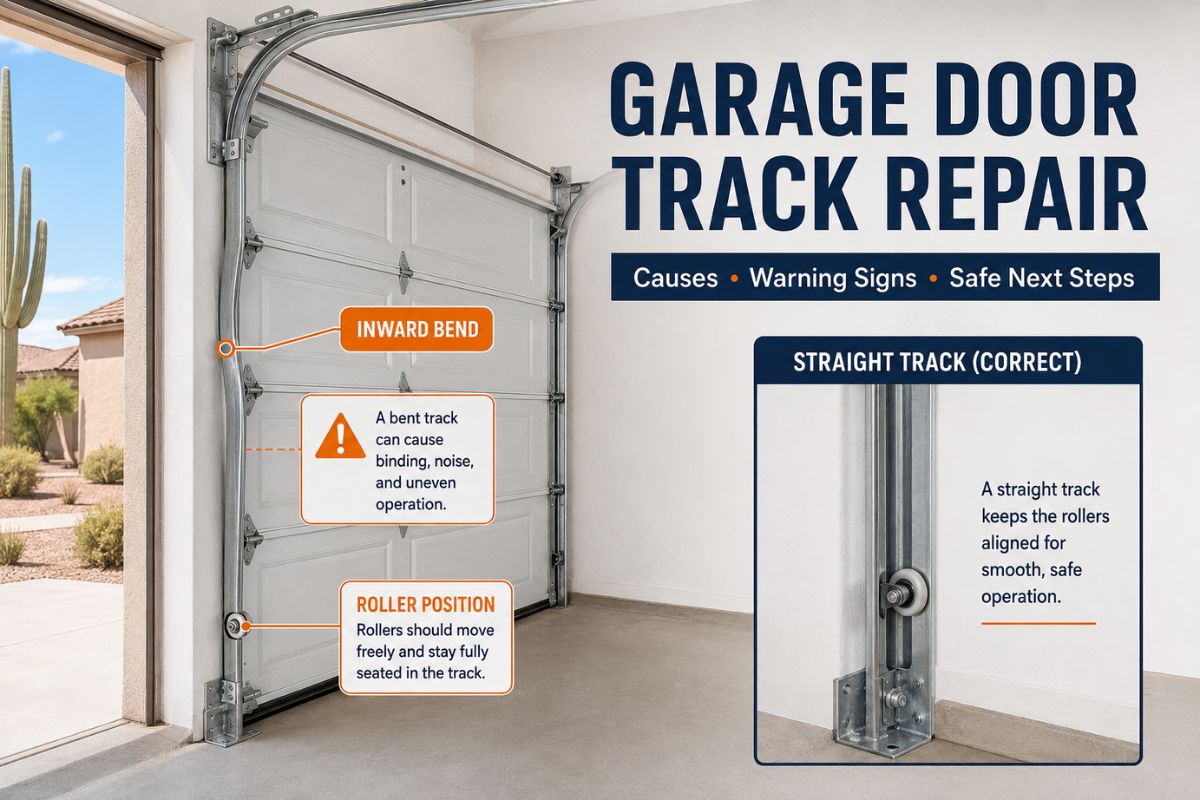
Garage door tracks are formed steel channels secured to the jambs, walls, ceiling supports, and rear hangers. Vertical tracks guide the door beside the opening; curved sections transition the rollers overhead; horizontal tracks support the door when open. Damage anywhere along that path can change roller clearance or alignment.
Impact near the opening
A vehicle mirror, ladder, trash container, storage rack, or other equipment can strike a vertical track. The damage may look small from the front while the channel has narrowed enough to catch a roller. An impact can also loosen a jamb bracket or damage the wall material behind it.
Loose mounts and vibration
Repeated door cycles create vibration. If a bracket, rear hanger, or fastening surface loses stability, the track can move under the weight of the door. Tightening a visible screw is not automatically the correct fix: the mounting surface may be damaged, or the track may need to be repositioned and measured before it is secured.
Roller, hinge, or door problems
A worn roller may drag instead of rotating freely. A loose hinge can change the angle of its roller stem. A damaged panel can rack the door as it travels. These faults can push rollers against the edges of the channel and eventually deform the track. Our garage door roller replacement and panel repair pages explain those connected components.
Uneven lifting forces
Cables and springs help lift the door evenly. A door that rises faster on one side can twist in the opening and drive a roller toward the track edge. Cable and spring systems store substantial energy; do not adjust them as part of a track repair. Use professional cable repair or spring service when those components are involved.
Signs of a Bent Track
A bent track may be visible, but door behavior often reveals the problem first. Watch the door from a safe distance and stop the opener if the movement becomes uneven or the rollers no longer remain fully contained.
- A visible inward pinch, twist, flare, dent, or crease in the steel channel
- Scraping, popping, grinding, or clicking at the same point on every cycle
- A roller that hesitates, rubs the track edge, or begins to leave the channel
- A door that becomes crooked or develops a different gap on each side
- Track brackets moving against the wall or jamb as the door travels
- A gap between the track bracket and its mounting surface
- A door that reverses or stops before reaching the floor
- New damage after a vehicle or stored item contacts the track
Noise alone does not prove the track is bent. Loose debris, worn rollers, dry bearings, hinges, opener components, and door imbalance can all produce sound. Observe where the noise happens and whether the roller remains centered in the channel. Our guide to opener repair and installation covers failures originating above the door rather than at the tracks.
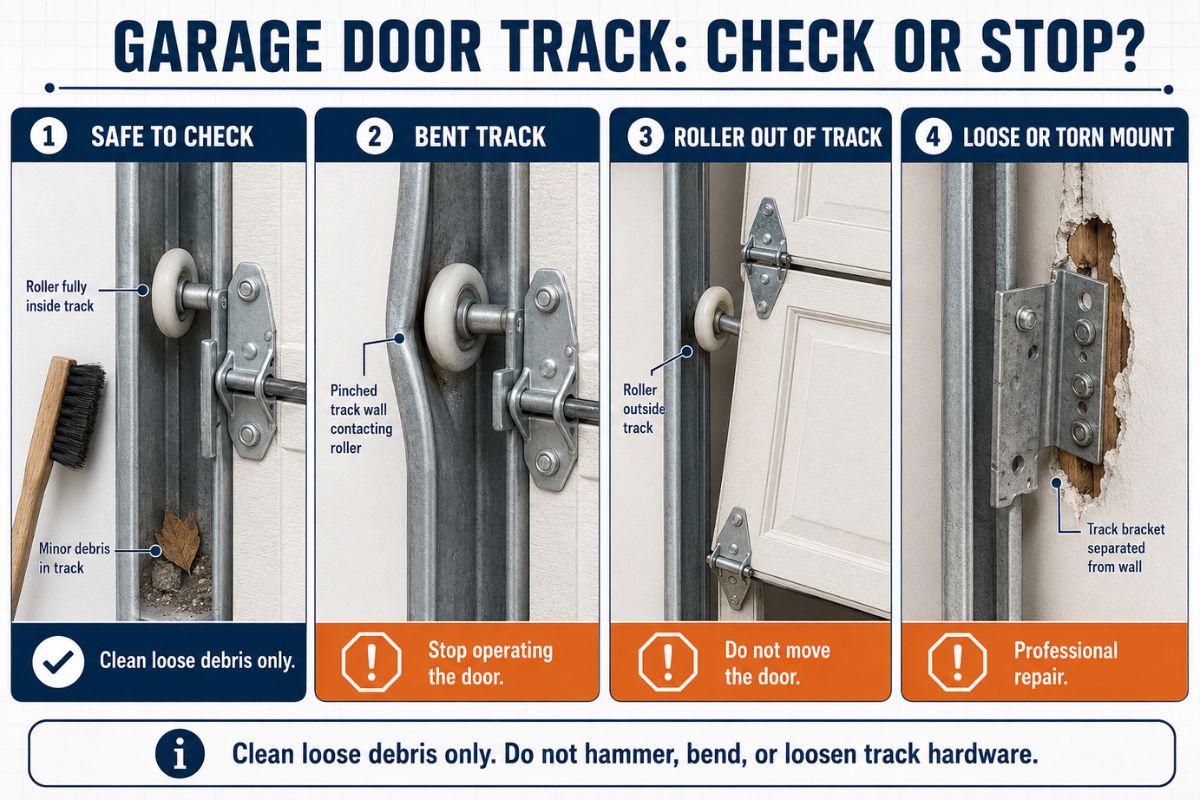
A roller outside the track is not a minor alignment issue. The door’s weight and spring forces can make the sections shift without warning. Do not try to push the roller back, pry the channel open, disconnect a cable, or manually lift the door.
Minor Fixes You Can Try
Safe homeowner actions are limited to clearing loose debris and documenting what you observe. Do not hammer the rail, bend it with pliers, loosen track brackets, or operate the door repeatedly to “work through” a tight spot.
1. Stop and inspect from a distance
If the door is fully open, stable, and operating normally, look along each track for loose debris, visible dents, moving brackets, or fresh scrape marks. Do not place fingers inside the channel or between door sections.
2. Remove loose debris
Disconnect opener power according to the manufacturer’s instructions. With the door secured in a safe, fully open position and no signs of damage or imbalance, use a soft brush to remove loose leaves, webs, and dry surface dirt. Wipe the accessible channel with a slightly damp cloth, then dry it.
3. Do not grease the track
The track is a guide channel, not a surface that should be packed with grease. Heavy lubricant can collect Arizona dust and create buildup. Follow the door manufacturer’s instructions for lubricating approved moving parts such as specific roller bearings and hinges. Nylon roller wheels may have different maintenance requirements.
4. Record the exact symptom
Note where the door catches, which side makes noise, and whether a bracket moves. A short video recorded from a safe distance can help a technician understand an intermittent problem. Do not continue cycling the door once a roller binds or the door becomes uneven.
Clopay’s official replacement-parts and maintenance guide recommends brushing and wiping debris from tracks, while directing bent or twisted track issues to a professional. That distinction is useful: cleaning is routine housekeeping; reshaping and aligning load-bearing track geometry is repair work.
When to Replace the Track
A track should be replaced when its shape or mounting integrity cannot be restored reliably, when the steel is torn or deeply creased, or when it is incompatible with the door system. The decision depends on damage location, material condition, door geometry, and available matching parts.
Conditions that favor replacement
- A sharp crease, split, or torn mounting hole
- Severe twisting that changes roller clearance
- Corrosion that has weakened the steel or fastener points
- Repeated deformation after earlier straightening
- A damaged transition curve or horizontal section
- An incompatible rail paired with a replacement door
- Wall or ceiling mounting damage that requires reconstruction and realignment
DASMA’s garage door system safety guidance notes that old track may not fit a replacement door because section thickness, door weight, headroom, opener location, and other requirements vary. The door and track are designed as a system; reuse should not be assumed.
A minor, localized deformation may sometimes be professionally corrected when the steel remains sound and the channel can be returned to the manufacturer’s intended geometry. That decision should follow measurements of track spacing, plumb, level, bracket stability, roller condition, and door balance.
Replacement alone is incomplete if the impact also bent a hinge, damaged a panel, loosened a jamb, or forced a roller out. A complete track repair and realignment visit should identify the initiating damage and confirm smooth manual and powered travel before the system returns to service.
Track Repair in Arizona
Arizona garages commonly collect fine dust and windblown debris near the vertical tracks. Heat and daily cycling can make loose mounting or worn rollers more noticeable, but climate should not be used to explain away a visible bend, moving bracket, or crooked door.
Keep storage racks, ladders, bins, and vehicles clear of the tracks. Include bracket stability, rollers, hinges, door balance, sensors, and opener behavior in periodic garage door maintenance. For commercial facilities, loading activity and higher cycle counts justify a documented preventive maintenance program.
Professional garage door track repair in Arizona should address track geometry and the conditions that damaged it. Garage Door AZ LLC can inspect residential track, rollers, brackets, panels, cables, springs, and opener operation. The company’s Arizona contractor license is ROC 351695. Learn about our service approach or review our full residential garage door services.
Frequently Asked Questions — Garage Door Track Repair
Schedule Garage Door Track Repair in Arizona
A stable track keeps each roller contained and allows the door to follow its intended path. If the track is bent, loose, torn from its mount, or allowing a roller to escape, do not continue cycling the door. Call Garage Door AZ at (480) 530-7131, use our contact page, or visit our Google Business profile to request garage door track repair in the Phoenix metro area.