
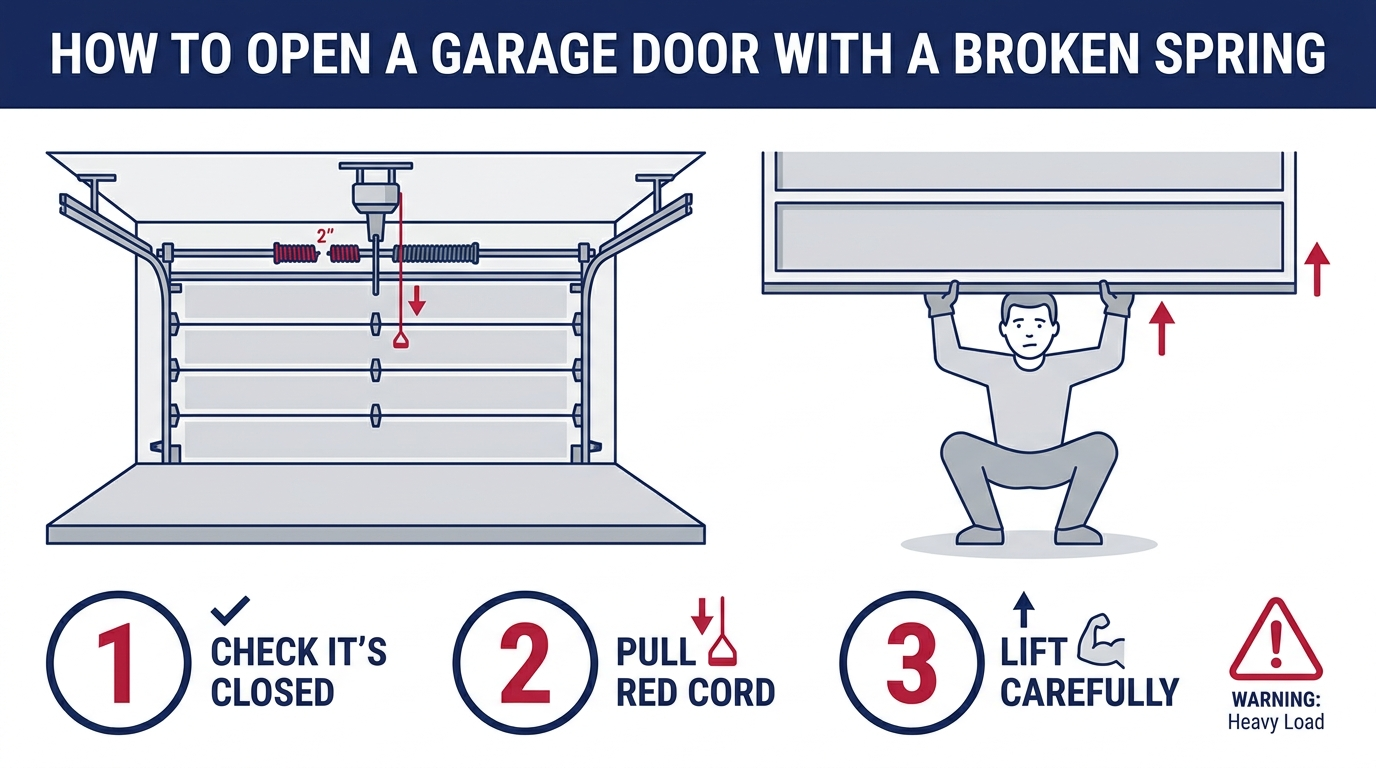
To open a garage door with a broken spring, only do it while the door is fully closed: pull the red emergency release cord to switch the door to manual mode, then lift slowly with both hands, knowing the door will feel extremely heavy because the spring that normally carries its weight is gone. If the door is stuck open, or feels like it might slam down, leave it alone and call a technician. This guide shows you the safe way to do it, the mistakes that send people to the ER, and why the spring itself is never a DIY fix.
A broken spring is the single most common reason a garage door suddenly stops working, and it is the repair we respond to most across Mesa, Phoenix, and the East Valley. The spring does the real lifting, so when it snaps you are left with a 130-to-400-pound slab of steel and no counterbalance. Below, our licensed team at Garage Door Arizona — ROC #351695 walks you through exactly what to do — and what not to do.
Is It Safe to Open It?
Sometimes yes, sometimes no — and knowing the difference is what keeps your hands and feet intact. The answer depends entirely on where the door is when the spring breaks. Learning how to open a garage door with a broken spring starts with reading that one detail correctly.
A garage door spring stores enormous energy to counterbalance the door’s weight. When it breaks, that counterbalance disappears. A closed door resting on the floor holds no stored energy, so moving it by hand is controlled — heavy, but predictable. A door stuck partway up or fully open is a different animal: nothing is holding it there but friction, and it can drop without warning.
When It’s Reasonably Safe
- The door is fully closed and flat on the floor. This is the only scenario where a careful homeowner should attempt a manual lift.
- You can get a firm two-handed grip on the lifting handles or the bottom panel.
- You have a second person to help — a door without a working spring can weigh as much as a refrigerator.
When You Should Stop and Call a Pro
- The door is stuck open or partway up. Do not walk or park under it. Pulling the release now can drop the panel instantly.
- You also hear or see a loose or broken cable. A failed cable makes the door unbalanced and unpredictable.
- The door feels like it wants to slam. Trust that instinct — book emergency garage door repair instead.
🔍 How to Know a Spring Is Broken
- A loud bang from the garage. A snapping torsion spring sounds like a firecracker — many homeowners think something fell.
- The opener strains, then stops. The motor hums or moves the door an inch or two, then gives up because it can’t lift the full weight alone.
- A visible gap in the spring. Look at the spring above the door on the metal shaft — a two-inch gap in the coil means it’s snapped.
- The door slams shut fast. With no counterbalance, a closing door drops much faster than normal.
Step-by-Step Manual Opening
If your door is fully closed and you’ve confirmed it’s safe to proceed, here is the correct sequence. Work slowly, keep children and pets clear of the garage, and stop the moment anything feels wrong.
Pull the Red Cord
Every automatic opener has a manual override: the red handle hanging from the opener rail near the center of your garage. This is your garage door emergency release cord, and it disconnects the door from the powered opener so you can move it by hand.
- Confirm the door is fully down. Never pull the cord while the door is raised.
- Grip the red handle and pull it straight down, then back toward the motor unit. You’ll feel and hear the trolley click free from the carriage.
- The door is now in manual mode. The opener will no longer move it — you’re lifting it yourself from here.
Lift Carefully
This is the moment to respect the weight. With the spring broken, nothing is helping you lift — you are raising the door’s entire mass.
- Position yourself square to the door with your feet apart, knees bent, and back straight. Lift with your legs, not your back.
- Grip the bottom panel or the lifting handles with both hands. Keep your fingers away from the section joints — they pinch hard.
- Raise the door in one smooth, controlled motion. If a helper is available, lift together on each side so it comes up evenly.
- Prop it open securely. Because there’s no spring to hold it, clamp locking pliers on the track just below a roller, or wedge a sturdy 2×4 under each side. Do not rely on the door staying up on its own.
- Get your vehicle out, then lower the door slowly and leave it closed until a technician arrives. An unsupported open door can fall.
What NOT to Do
More people are hurt in the minutes after a spring breaks than by the break itself. These are the mistakes we see most often — and the ones that turn a simple service call into an emergency-room visit.
⚠️ SAFETY WARNING — Read Before You Touch the Door
A broken garage door spring leaves the door with no counterbalance, and the second spring (if your door has two) may fail at any second. Never stand under a raised door, never force the opener, and never attempt to wind or replace the spring yourself. If you’re unsure, stop and call a licensed technician at Garage Door Arizona — ROC #351695.
- Don’t keep pressing the opener button. Forcing the motor to lift a spring-less door burns out the opener, strips its gears, and can pull the door off its track — turning one repair into three.
- Don’t stand or reach under a raised door. Without a spring, only friction is holding it up. If it drops, it drops with full force.
- Don’t try to open it if a cable is also broken. A door with a failed spring and a loose cable is off-balance and unsafe to move by hand.
- Don’t leave the door propped open unattended. Kids, pets, or a bumped brace can send a heavy panel crashing down.
- Don’t attempt to replace or “adjust” the spring. This is the big one — covered next.
Why You Need a Pro for the Spring
It’s tempting to order a spring online and call it a Saturday project. It isn’t. A garage door spring replacement and repair is one of the most dangerous home jobs there is, and the danger has nothing to do with the part’s price and everything to do with the energy it stores.
Here’s what makes spring work genuinely hazardous:
- Torsion springs are wound under extreme tension. A spring holds enough stored force to lift a 400-pound door — and enough to break a wrist, jaw, or worse if it releases wrong.
- Winding bars can become projectiles. If a bar slips while the spring is under load, it can whip out with the force to punch through drywall.
- The wrong spring makes it worse. Springs are sized to a specific door weight, height, and cycle life. A mismatch leaves the door unbalanced and burns out the opener.
- Springs work as a pair. When one fails on a two-spring door, the other is at the end of its life too — pros replace both to keep the door balanced.
- It’s a leading cause of garage-door injuries. Thousands of people land in ERs each year, and a large share are homeowners doing spring and cable work without the right tools or training. The Door & Access Systems Manufacturers Association treats spring service as a professional task for exactly this reason.
A trained technician arrives with the correct winding bars, matched replacement springs, and the experience to release and re-tension the system safely — usually in under an hour.
Spring Replacement in Arizona
Desert conditions are hard on garage door springs. Summer heat above 110°F and the daily open-close cycle fatigue the steel faster than in milder climates, which is why so many Valley doors lose a spring right in the heat of the season. A standard residential spring is rated for roughly 10,000 cycles — about 7 to 10 years of normal use — but Arizona’s temperature swings and heavy garage use can shorten that window.
For most homes, professional spring replacement runs about $200 to $350 for a single torsion spring including parts and labor, and roughly $300 to $500 to replace both springs on a two-spring door. Replacing both at once is the smarter move — the labor is nearly the same, and it keeps the door balanced so you’re not back to square one in a few months. If your door is aging and repairs are stacking up, a new garage door installation can be the better long-term value.
We provide same-day service and 24/7 emergency response across the Valley, including Mesa, Phoenix, Chandler, Gilbert, Scottsdale, and Tempe. Every job includes an upfront written quote, and a yearly maintenance and tune-up is the cheapest way to catch a tired spring before it snaps. Explore our full range of residential garage door services or learn more about our team.
Frequently Asked Questions
Can I open my garage door with a broken spring?
Yes, but only if the door is fully closed. Pull the red emergency release cord to switch to manual mode, then lift slowly with both hands and, ideally, a second person — the door will feel very heavy. If it’s stuck open or a cable is also broken, don’t try; call a technician instead.
Is it safe to use the opener when a spring is broken?
No. The opener isn’t built to lift the door’s full weight without the spring’s help. Running it burns out the motor, strips the gears, and can pull the door off its track. Disconnect the opener with the release cord and operate the door manually until it’s repaired.
How heavy is a garage door with no spring?
Most residential doors weigh 130 to 200 pounds, and insulated or double doors can exceed 300 to 400 pounds. Without a working spring you’re lifting all of it, which is why a two-person lift and a proper leg-powered technique matter.
Can I just replace the spring myself?
We strongly advise against it. Torsion springs are wound under extreme tension, and a slip can cause serious injury. The job also requires correctly sized springs and winding bars. A licensed technician handles it safely, usually in under an hour, with an upfront quote.
How much does garage door spring replacement cost in Arizona?
Expect roughly $200 to $350 for a single torsion spring and about $300 to $500 to replace both, including parts and labor. Replacing both at once keeps the door balanced and avoids a repeat visit. Call (480) 530-7131 for an upfront written quote.
Do you offer same-day spring repair near me in the Phoenix area?
Yes. Garage Door Arizona provides same-day appointments and 24/7 emergency service throughout Mesa, Phoenix, Chandler, Gilbert, Scottsdale, Tempe, and Guadalupe. Call (480) 530-7131 or visit our Phoenix service area page to confirm coverage.
Get Your Broken Spring Fixed Safely — Today
A broken spring turns a smooth, balanced door into a heavy, unpredictable hazard in an instant. The good news: if the door is closed, you can get your car out by pulling the red release cord and lifting carefully — but the spring itself belongs in trained hands. Forcing the opener or attempting the swap yourself is how a routine repair becomes an injury.
Dealing with a broken spring right now? Don’t force the door. Call Garage Door Arizona at (480) 530-7131 for same-day spring replacement, reach us through our contact page, or find us on our Google Maps listing in Mesa. Licensed under ROC #351695, built for the desert, and ready when your spring gives out.