
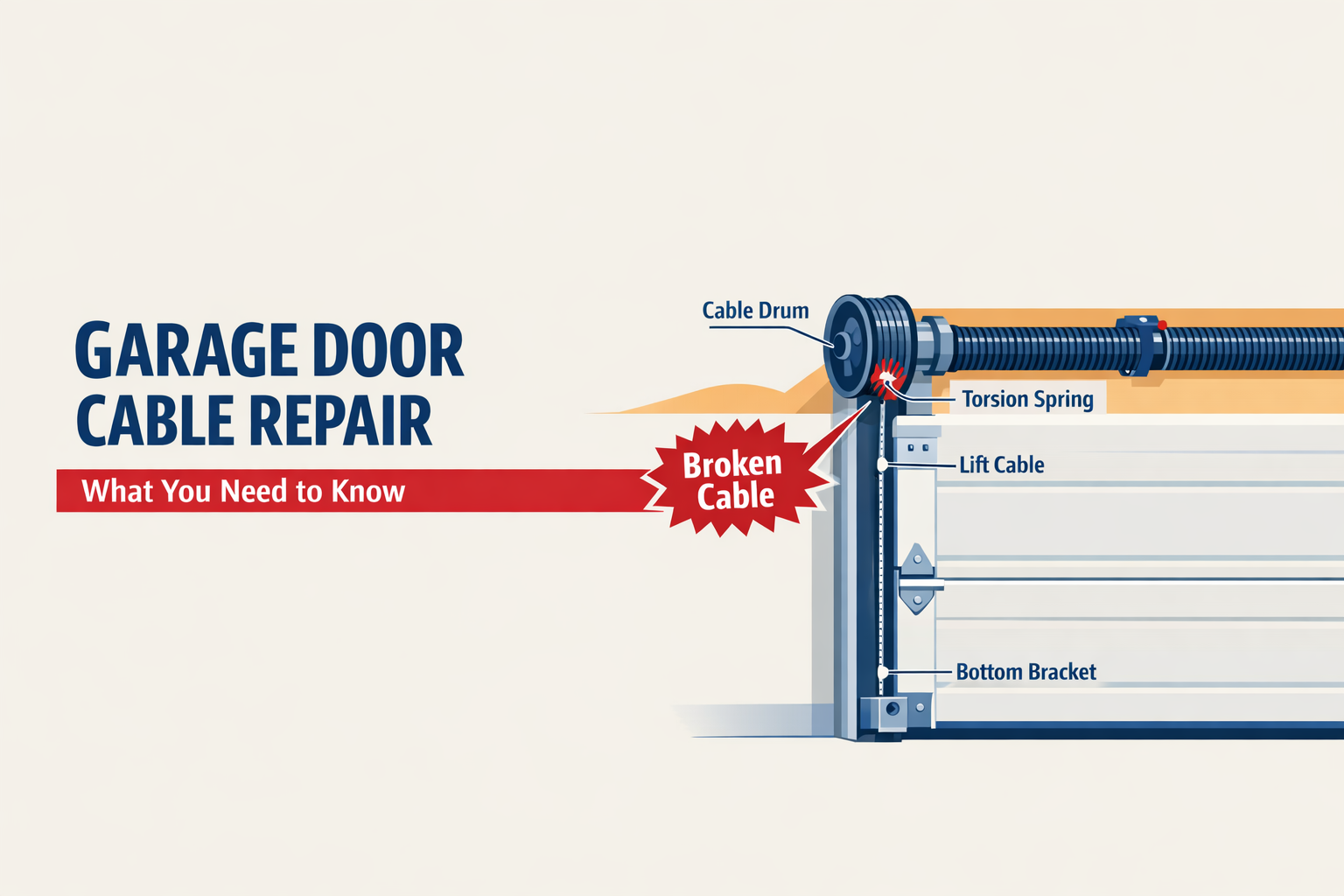
Garage door cable repair is the fix for the two thin steel cables that lift and lower your door in sync with its springs. When a cable frays, slips off its drum, or snaps, the door goes crooked, jams, or crashes down — and because those cables work under the same extreme tension as the springs, this is one repair you should not DIY. Here’s how the system works, how to spot a failing cable, and what a safe, professional repair actually involves.
We’ve spent more than a decade replacing lift cables on doors across Mesa, Phoenix, and the East Valley, and cable failures are among the most common — and most misunderstood — problems we see. This guide walks you through everything a homeowner should know before touching a cable, and exactly when to hand it to a licensed technician at Garage Door Arizona — ROC #351695.
How Garage Door Cables Work
Your garage door weighs anywhere from 130 to over 400 pounds, yet it glides up with the touch of a button. The reason is a balanced system in which the springs do the heavy lifting and the cables transfer that lifting force to the door itself. Understanding the relationship between the two is the key to understanding why garage door cable repair is never a casual weekend project.
Each side of the door has one galvanized-steel lift cable. The bottom of the cable attaches to a bottom bracket fixed to the lowest door panel. The top of the cable winds around a grooved cable drum mounted on the torsion shaft above the opening. As the spring winds and unwinds, it turns the shaft, the drums spool or unspool the cables, and the door rises or lowers evenly on both sides.
Torsion vs. Extension Cable Systems
There are two common configurations, and the cable’s job differs slightly in each:
- Torsion systems use a spring mounted on a shaft above the door. The cables wrap around drums on that shaft. This is the most common setup on modern doors and the one most cable failures involve.
- Extension systems use springs stretched along the horizontal tracks. Here the cables — including a critical safety cable threaded through the spring — route through pulleys to raise the door.
In both cases, the cable is under load the entire time the door is up. That stored energy is why a spring and its cable are treated as a single high-tension unit. Replace or adjust one and you’re working within inches of the other.
🔧 What Makes Cables Fail in Arizona
- Rust and corrosion. Even in the dry desert, monsoon humidity and swamp-cooler moisture rust the strands where the cable meets the bottom bracket.
- Fraying at the drum. A cable that rides a worn or misaligned drum slowly shears strand by strand until it lets go.
- Spring wear. When a spring loses tension, the cables carry uneven load and jump the drum. Cable and spring problems usually travel together.
- Age. Most lift cables last 8–12 years. Arizona’s heat cycles and daily use push older cables toward the end of that window fast.
Signs of a Broken Cable
A failing cable rarely gives out silently. Catching the warning signs early can turn an emergency into a routine garage door cable repair and replacement visit. Use the quick-diagnosis table below to match your symptom to the most likely cause.
| What You Notice | Likely Cable Issue | What to Do |
|---|---|---|
| Door hangs crooked / one side lower | One cable slipped the drum or snapped | Stop using it; call a pro |
| Frayed, rusty strands near the bottom | Cable is wearing through | Schedule replacement before it fails |
| Loud bang, then door won’t move | Cable or spring snapped — STOP | Do not operate; call now |
| Cable dangling loose beside the door | Cable came off the drum | Leave the door down; call a pro |
| Door jerks, catches, or is hard to lift | Uneven cable tension / worn drum | Book an inspection |
The Warning Signs, One by One
- A visibly crooked door. When one cable fails, that corner drops while the other holds. A door hanging at an angle is the single clearest sign of a cable problem — and a signal to stop pressing the button.
- Frayed or rusted strands. Look at the cable where it meets the bottom bracket. Broken “whiskers” of steel or orange corrosion mean the cable is losing strength and a full garage door cable replacement is due.
- A cable hanging loose. If a cable has unspooled and is dangling, it has jumped the drum. The door is now held by one cable and is unbalanced.
- Grinding, jerking, or uneven travel. Cables that are stretched or spooling unevenly make the door catch and shudder. Worn rollers or a bent track can compound the problem.
- A loud snap. A cable or spring letting go sounds like a firecracker or a gunshot. If you heard one and the door won’t move, treat it as a broken high-tension part.
Why DIY Is Dangerous
It’s tempting to look at a $15 pair of cables online and assume this is a quick fix. It isn’t. The danger has nothing to do with the cable’s price and everything to do with what the cable is connected to: a torsion spring wound with enough stored energy to lift a 400-pound door — and enough to seriously injure anyone who releases it wrong.
Here’s what makes cable work genuinely hazardous:
- Spring tension doesn’t forgive mistakes. To swap a cable you first have to release or control the spring’s tension. If a winding bar slips, the spring can unwind instantly and throw the bar with enough force to break a wrist or jaw.
- A loaded cable whips. Pull on or try to re-spool a tensioned cable and it can snap back with the force of a whip.
- The door can drop. With one cable off, most of the load shifts to the other side. Disturb the balance and a heavy door can crash to the floor.
- It’s a leading cause of ER visits. Thousands of garage-door injuries land people in emergency rooms every year, and a large share happen when homeowners take on spring and cable work without the right tools or training.
⚠️ SAFETY WARNING — Do Not DIY Cable or Spring Work
Garage door lift cables carry the full weight of the door, and the torsion springs they work with are wound under extreme tension. Releasing that energy without the correct winding bars and technique can cause severe injury. If you have a broken, frayed, or slipped cable, stop operating the door and call a licensed technician. Our team at Garage Door Arizona — ROC #351695 carries the right tools, replacement cables, and insurance to handle it safely.
The Repair Process
A professional garage door cable repair is fast when it’s done right — most jobs take under an hour — because the technician follows a disciplined sequence built around controlling spring tension at every step. Here’s what happens on a typical service call so you know what to expect:
- Secure the door. The technician clamps the door in place with locking pliers on the track so it can’t move while the cables are off tension.
- Release spring tension safely. Using proper winding bars, they carefully unwind the torsion spring — or unhook the extension spring — until the cables are slack.
- Remove the old cables. Both cables come off the bottom brackets and off the drums. Pros almost always replace both cables at once, even if only one failed, to keep the door balanced.
- Install matched replacement cables. New galvanized cables sized to the door’s height and weight are seated in the bottom brackets and wound onto the drums.
- Re-tension and balance. The spring is wound back to spec and the drum set screws are locked so both cables carry equal load. The door should sit level and stay put at any height.
- Test and inspect. The technician cycles the door several times, checks the tracks and opener, and confirms the reversing safety features work before finishing.
What Cable Repair Usually Costs
For a typical home, professional cable replacement runs about $150 to $250 for both cables including parts and labor, with more complex or emergency jobs reaching $250–$350+. The cables themselves are inexpensive; you’re paying for the training and tools that make the high-tension work safe. If your springs are also worn — common when cables fail — bundling a spring replacement into the same visit saves a second service fee. When repairs start stacking up on an aging door, a new garage door installation can be the smarter long-term move.
Cable Repair in Arizona
Desert conditions are tough on garage door hardware. Summer heat above 110°F expands metal and dries out lubricant, while monsoon humidity and swamp-cooler moisture quietly corrode cables where they anchor to the bottom bracket. That’s why a cable that looked fine last winter can shear through in July. We size and install every cable with Arizona’s climate in mind, using corrosion-resistant galvanized cable rated for daily desert use.
We provide same-day service and 24/7 emergency response across the Valley, including Mesa, Phoenix, Chandler, Gilbert, Scottsdale, Tempe, and Guadalupe. Managing a storefront or warehouse door instead? Our commercial garage door service covers that too.
Every Garage Door Arizona technician works under our ROC #351695 Arizona contractor license, arrives with the correct winding bars and OEM-grade cables, and starts each visit with a transparent diagnosis and an upfront written quote. You can learn more about our team or book through our contact page.
Frequently Asked Questions
Can I still use my garage door with a broken cable?
No. With one cable broken, the door is unbalanced and the remaining cable and spring are overloaded — the door can crash down or the second cable can snap. Stop using the opener, leave the door closed, and book a professional cable repair. Forcing it risks injury and further damage.
Should I replace one cable or both?
Always both. Cables wear at the same rate, so if one has failed the other is close behind. Technicians replace both to keep the door balanced and to avoid a second service call within months. The parts are inexpensive — the labor and tension work are the same whether you change one cable or two.
How much does garage door cable repair cost?
Most homeowners pay roughly $150 to $250 to replace both cables, including parts and labor, with emergency or complex jobs running $250–$350 and up. If the springs are also worn, combining the two repairs in one visit is more cost-effective. We provide an upfront written quote before any work begins — call (480) 530-7131.
Why did my garage door cable come off the drum?
Usually because the door lost tension or hit something — a weak spring, a door that closed on an obstruction, or a bottom bracket that shifted lets the cable go slack and jump the grooved drum. It can also happen after a botched spring change. A technician re-seats the cable, checks the drum and spring, and re-balances the door so it doesn’t recur.
How long do garage door cables last?
Typically 8–12 years, depending on cycles and climate. In Arizona, heat and monsoon-season moisture can shorten that lifespan, so a yearly maintenance and tune-up that catches fraying early is the cheapest insurance against a sudden failure.
Do you offer same-day cable repair near me in the Phoenix area?
Yes. Garage Door Arizona provides same-day appointments and 24/7 emergency service throughout Mesa, Phoenix, Chandler, Gilbert, Scottsdale, Tempe, and Guadalupe. Call (480) 530-7131 or visit our Phoenix service area page to confirm coverage for your neighborhood.
Get Your Garage Door Cable Fixed Safely — Today
A broken lift cable turns a smooth, balanced door into a heavy, unpredictable hazard in an instant. The good news: once you recognize the signs — a crooked door, a dangling or frayed cable, a loud snap — the fix is quick and affordable in trained hands. The high-tension work behind it, though, is exactly where a licensed team keeps you safe.
Spotted a cable problem? Don’t force a damaged door. Call Garage Door Arizona at (480) 530-7131 for same-day garage door cable repair, or find us on our Google Maps listing in Mesa. Licensed under ROC #351695, built for the desert, and ready when your cable gives out.