
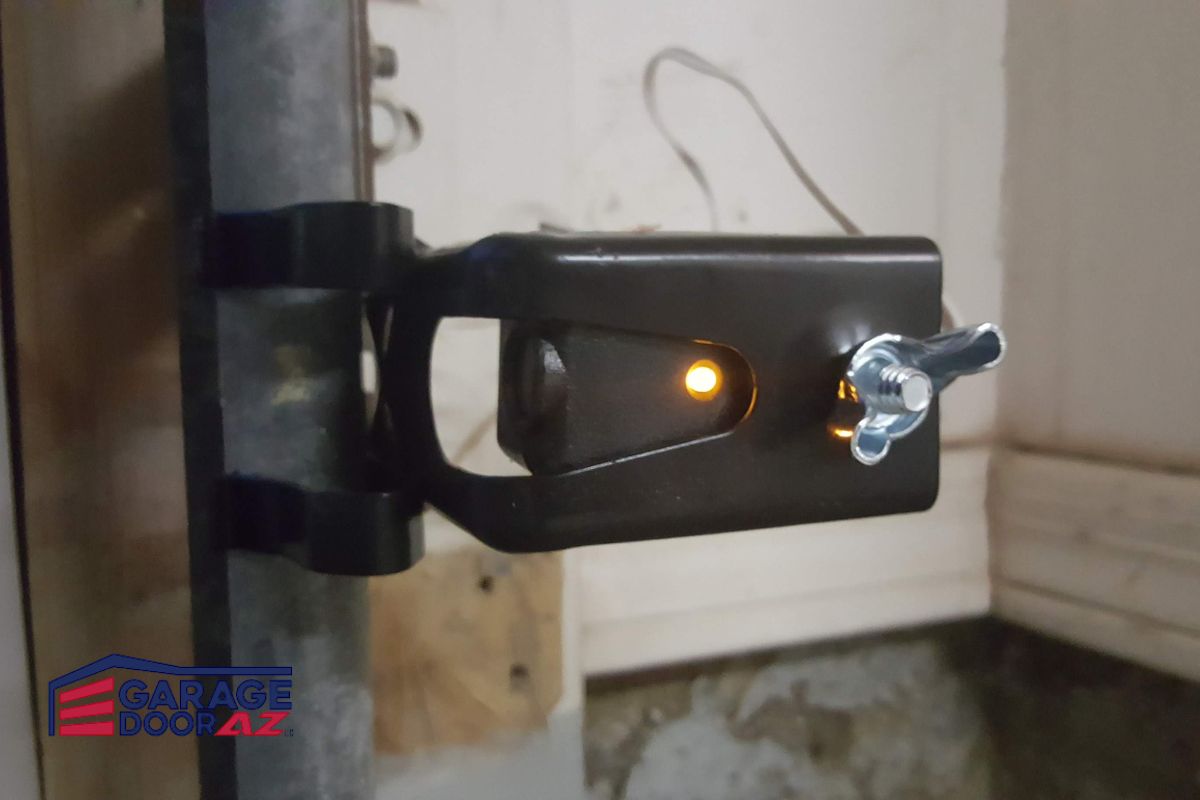
Most “sensor problems” in Arizona are actually signal-reliability failures: dust film attenuates the infrared beam, heat expansion shifts brackets by millimeters, and door vibration from imbalance or track drag knocks alignment out of tolerance. The opener’s control logic correctly interprets a weak beam as an obstruction and reverses. The fix is restoring optical stability and verifying door travel loads.
Arizona homeowners usually notice it first as a door that refuses to close, reverses for no obvious reason, or flashes an error light after windy days. That pattern tracks the climate: dust coats the photo-eyes, heat changes mounting geometry, and a door that’s running rough amplifies vibration near the floor—right where sensors live.
The technical cause is rarely “just electronics.” A weak beam can be optical (dirty lenses), mechanical (misaligned brackets), electrical (intermittent wiring), or systemic (opener force events caused by binding or imbalance). Correct service focuses on reliability, not quick workarounds.
For the most direct path to a safe, compliant solution, start with professional photo-eye diagnostics and stabilization through our garage door safety sensor repair and alignment service. The goal is to confirm what’s truly failing—beam quality, mounting integrity, wiring stability, or door mechanics.
Why diagnostics matter: misdiagnosing sensors can lead to repeat reversals, opener strain, and a door that becomes unpredictable under load—especially in peak summer heat.
Bold takeaway: A stable door makes sensors stable. Sensors don’t “fix” a rough-running door.
How Safety Sensors Work
Most residential systems use photo-electric “photo-eye” sensors mounted near the floor on each side of the opening. One unit emits an infrared beam; the other receives it. During closing, the opener continuously validates beam continuity:
-
If the beam breaks, the opener reverses (entrapment protection).
-
If beam strength becomes marginal, the opener may refuse to close or reverse intermittently.
-
If the door binds and motor load spikes, the opener may reverse even if sensors are fine (force-sensing logic).
In practice, “sensor failure” commonly means one of these conditions:
-
Optical attenuation: dust film, haze, scratches, or sun-angle interference reduces received signal.
-
Angular misalignment: brackets drift so the receiver sees only part of the beam.
-
Electrical intermittency: vibration and heat cycles stress connectors, wires, or terminals.
-
Logic conflict: the opener detects abnormal resistance from mechanical issues and behaves as if there’s an obstruction.
If you want a system-level overview of how these issues connect to repair categories, browse our garage door services page and the residential garage door service section.
Bold takeaway: Sensors are a safety system. Treat inconsistent sensor behavior as a safety warning, not a nuisance.
Why Arizona Is Hard on Sensors: Heat, Dust, UV, and Vibration
Arizona heat expansion (small shifts, big impact)
Heat expands metal brackets, track supports, and mounting screws. Sensors operate on precise alignment; a small bracket shift can reduce beam capture enough to create “random” reversals.
Dust infiltration (beam weakening over time)
Fine desert dust coats lenses and scatters infrared light. A thin film can turn a strong beam into a marginal signal—especially after windy days in Phoenix and surrounding areas.
UV seal degradation (drag increases vibration)
UV hardens bottom seals and perimeter weatherstripping. When the bottom seal drags on the slab, the opener sees resistance spikes and the door vibrates at the end of travel—exactly where photo-eyes become most critical.
Vibration from rough travel (the hidden multiplier)
Most repeat sensor issues trace back to door vibration, often caused by:
-
track gauge misalignment,
-
roller wear (nylon vs steel),
-
panel structural stress and hinge play,
-
imbalance from spring fatigue.
Bold takeaway: Dust weakens the beam; vibration breaks alignment; heat makes both worse.
The Mechanical Chain Behind “Sensor” Symptoms
When a door runs smoothly, sensors stay aligned and the opener closes consistently. When mechanics degrade, sensor errors become frequent.
Torsion springs vs extension springs
Springs counterbalance door weight. As springs fatigue, the door becomes effectively heavier and can travel unevenly—especially in torsion setups where torque must remain symmetrical. That imbalance increases operator motor torque load, leading to force reversals that look like sensor faults. If imbalance is suspected, the correct repair category is garage door spring replacement and repair.
Cable drum systems and end bearing plates
A torsion system relies on cable drums spooling evenly and bearing plates rotating with minimal resistance. When cable tension becomes uneven, the door can rack slightly during closing, shifting the bottom corners relative to the sensor beam. Cable wear concerns fall under garage door cable repair and replacement.
Track gauge misalignment
Track gauge and alignment control rolling resistance. Heat cycling and repeated vibration can pull tracks out of tolerance. Binding creates sudden load spikes that trigger opener reversal even with perfect photo-eyes. When binding is present, look to garage door track repair and realignment.
Roller wear: nylon vs steel
Worn rollers increase noise and transmit vibration into sensor brackets. Nylon rollers tend to run quieter and reduce vibration transfer; steel rollers can transmit more vibration if friction rises. Roller issues align with garage door roller replacement.
Panel structural stress
If panels flex, hinges loosen, or sections are stressed, the door may “walk” slightly as it closes, shifting the sensor line-of-sight. Structural issues may require garage door panel replacement and repair.
Bold takeaway: If the door shakes, sensors drift. Fix shake first—or you’ll chase sensors forever.
Opener Logic: Force Sensing, Limit Calibration, and Drive Type
Sensors are only one input. Modern openers also evaluate force and position.
Operator motor torque load
When rolling resistance increases—dust buildup, seal drag, track bind, imbalance—the motor draws more torque. The control board interprets abnormal load as a potential obstruction and reverses for safety.
Limit switch calibration concepts
Limit settings define open/close endpoints. When door travel becomes inconsistent, the opener can stop short, reverse near the floor, or “bounce” at the bottom—often misread as sensor failure. Proper evaluation belongs under garage door opener repair and installation.
Chain vs belt drive
-
Chain drive: robust, but it can transmit vibration and noise when the door is unbalanced.
-
Belt drive: quieter, but still sensitive to friction spikes and beam reliability.
Bold takeaway: A door can “pass” the sensor test and still reverse because force logic detects dangerous resistance.
Owner-Safe Maintenance Tips for Arizona Homes
You can support sensor reliability without touching high-risk components or attempting alignment changes.
Safe habits that reduce false reversals
-
Keep the sensor beam path free of stored items (bins, bikes, tools).
-
Reduce dust buildup near the floor zone (where sensors live).
-
Watch for pattern-based failures (after wind, late afternoon heat, or after months of increasing noise).
-
Treat new noises as early warnings of rising friction.
When maintenance should become professional service
Schedule a professional check when you see:
-
frequent reversals despite a clear opening,
-
an uneven or shaky closing motion,
-
repeated error behavior that returns after a short time.
For performance stability in Arizona conditions, many homes benefit from periodic garage door maintenance and tune-up service because it targets friction sources that destabilize sensors.
If the door becomes unsafe to operate or you need immediate stabilization, use emergency garage door repair.
Bold takeaway: You can manage environment and observation safely; professionals handle alignment, wiring, and load diagnostics.
What a Professional Checks During Sensor Safety Diagnostics
A correct service appointment verifies both optical reliability and the mechanics that keep it reliable:
-
Optical stability
-
Beam strength behavior, lens condition, and repeatable signal capture.
-
Mounting rigidity
-
Bracket stability under vibration and heat cycles.
-
Electrical integrity
-
Wiring condition, connection security, and intermittent fault checks.
-
Door travel smoothness
-
Whether the last 12–18 inches of closing is consistent (where sensors matter most).
-
Mechanical load mapping
-
Track gauge alignment, roller friction points, bearing resistance, cable drum consistency.
-
Opener behavior
-
Force-sensing thresholds and limit stability (verified safely, without bypass methods).
Bold takeaway: The best “sensor fix” removes the reason the beam keeps becoming unreliable.
Quick Diagnosis
Symptom → Likely Cause → What a Professional Checks
-
Door won’t close; opener flashes → Weak/blocked beam signal → Optical attenuation, bracket rigidity, wiring stability
-
Door reverses near the floor → Seal drag + force spike → Bottom seal drag profile, bind points, opener load behavior
-
Random reversals after wind → Dust film + vibration drift → Lens condition, bracket stability, door vibration sources
-
Works in morning, fails late afternoon → Heat expansion drift → Temperature-related bracket movement, mounting surfaces
-
One sensor indicator flickers → Electrical intermittency → Connector integrity, vibration stress points, continuity checks
-
Door shakes while closing → Track/roller friction → Track gauge alignment, roller wear patterns, hinge play
-
Opener strains loudly and reverses → Door imbalance raising torque load → Spring condition, cable drum consistency, bearing resistance
-
Commercial site sees frequent reversals → High-cycle wear + operator load → Operator torque behavior, guide friction, inspection status
Comparison Table: Sensor Issue vs System Issue
| What You Notice | Likely Category | Primary Risk | Best Next Step |
|---|---|---|---|
| Won’t close at all | Beam reliability | Safety failure | Sensor diagnostics |
| Reverses near floor | Force spike | Opener stress | Load + travel check |
| Random reversals | Dust/vibration | Unreliable closure | Stabilize mounts + mechanics |
| Flickering indicator | Wiring intermittency | Safety malfunction | Electrical integrity check |
| Noisy, shaky travel | Mechanical friction | Repeat failures | Track/roller evaluation |
Arizona Local Notes: Where Sensor Issues Show Up Most
Arizona garages differ by exposure and environment. Homes with:
-
west-facing doors (high heat load),
-
frequent wind-driven dust,
-
high daily cycles (families, rentals),
tend to see earlier sensor instability.
For local service coverage and scheduling, review:
-
garage door service in Mesa
…and the full Service Areas list for nearby cities like Chandler, Gilbert, Tempe, Glendale, Peoria, and Surprise.
FAQs: Garage Door Sensor Safety in Arizona
1) What affects the cost of garage door sensor service?
Cost depends on whether the issue is simple beam reliability (optics/mounting), electrical intermittency, or a deeper mechanical cause like track binding or imbalance. If diagnostics reveal friction or load spikes, the scope can expand to include related repairs that prevent repeat reversals.
2) How long do safety sensors last in Arizona heat and dust?
Sensors can last many years, but Arizona dust film and heat expansion can create frequent “false failures” if mounts loosen or lenses degrade. Reliability usually improves most when the door travels smoothly and vibration sources are corrected.
3) Is a door that won’t close an emergency?
It can be—especially if you can’t secure the garage or the door behaves unpredictably. If you need quick stabilization, emergency garage door repair helps restore safe function while preventing secondary damage.
4) Can bad springs cause sensor-like symptoms?
Yes. When springs lose torque, the door becomes heavier, motor torque load rises, and force-sensing reversals become more common. If imbalance is present, garage door spring replacement and repair is often part of the long-term fix.
5) How do pros separate sensor problems from opener force problems?
They test beam stability and wiring integrity, then compare it against door travel smoothness and opener load behavior. If the door binds or shakes, the “sensor symptom” is usually downstream of mechanical friction and needs system correction.
6) How long does a proper diagnostic appointment take?
Time depends on whether the problem is strictly optical/electrical or tied to door mechanics. A complete diagnostic verifies sensor reliability, door travel consistency, and opener logic so the issue doesn’t return after a short time.
7) What warranty considerations matter for sensor repairs?
Warranty factors include what components were replaced and whether the root cause was environmental (dust/heat) or mechanical stress (vibration/binding). Durable outcomes typically come from correcting the underlying load and vibration sources, not just replacing sensors.
8) What are the biggest safety risks if sensors malfunction?
A malfunctioning sensor system can compromise entrapment protection and increase risk to kids, pets, vehicles, and property. Treat sensor issues as safety-critical and avoid any workaround that bypasses protection systems.
Closing: Stable Door Mechanics Keep Arizona Sensors Safe
Most Arizona sensor problems trace back to dust-attenuated beams, heat-driven bracket drift, and vibration caused by imbalance or friction. When beam reliability drops, the opener responds correctly by refusing to close or reversing—because safety logic prioritizes entrapment protection.
The correct repair path restores sensor stability, verifies wiring integrity, and confirms smooth door travel by addressing the mechanical causes: track gauge alignment, roller wear, bearing resistance, cable drum consistency, and spring torque balance. This approach prevents repeat reversals and protects the opener from excessive motor load.
Garage Door Arizona serves Phoenix and nearby cities including Scottsdale, Mesa, Chandler, Gilbert, Tempe, Glendale, Peoria, and Surprise. To schedule service, call {PRIMARY_PHONE} or use our Contact page. You can also learn more about our approach on the About Us page or start from the Garage Door Arizona home.
Directions and reviews: https://share.google/El9weCH2SEf9OZYUS
Updates and tips on our social channels: https://www.facebook.com/GarageDoorAZ/
Safety reminder: High-tension spring systems and heavy commercial doors can move unpredictably under load—leave diagnostics and repairs to trained professionals.