
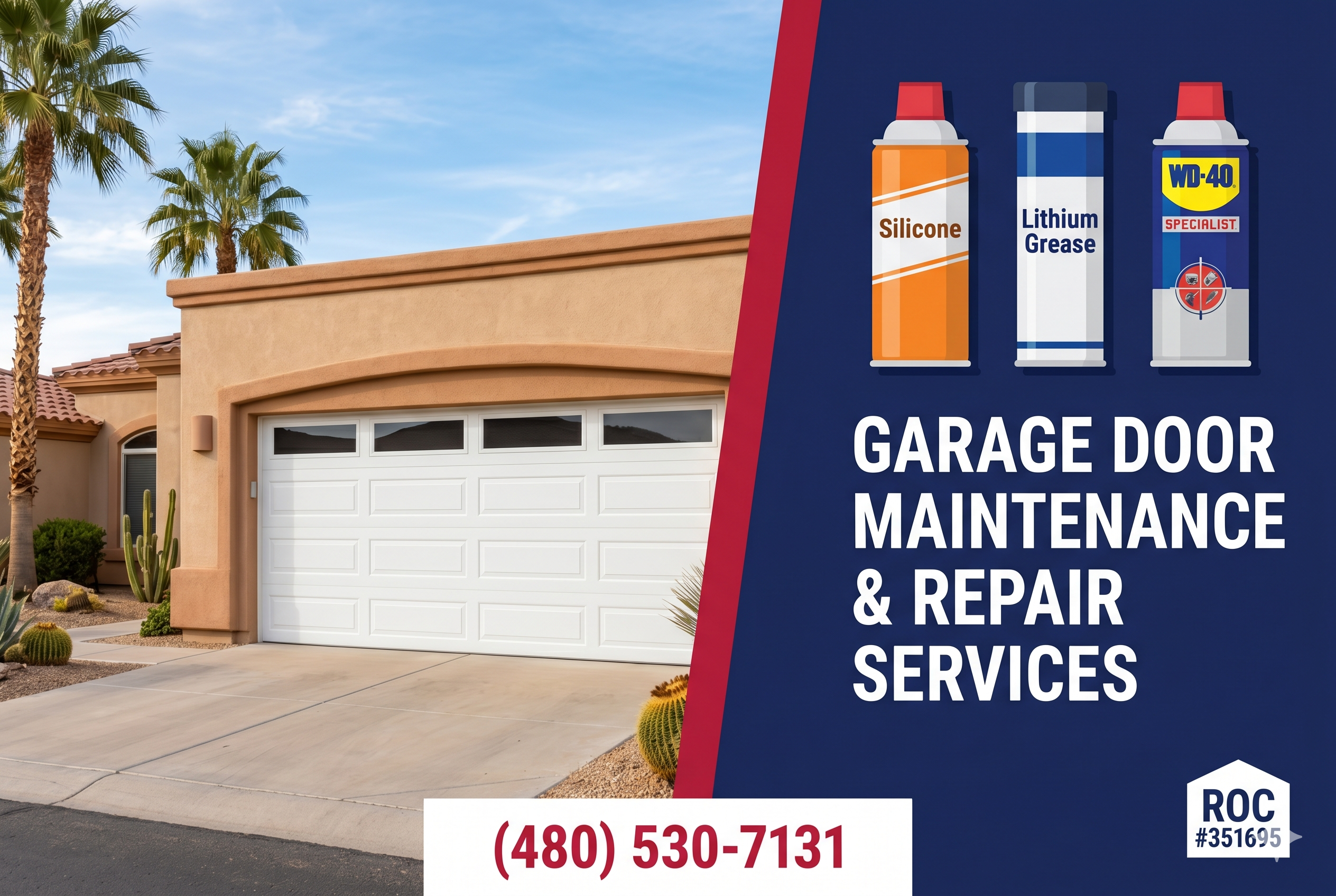
The best garage door lubricant for Arizona homes is a high-grade silicone spray or heat-stable white lithium grease. Standard oils, household grease, and original WD-40 break down fast in desert heat and pull dust into every moving part. The right product, applied to rollers, hinges, springs, and bearings every three to four months, keeps your door quiet, smooth, and safe.
We have spent more than ten years servicing garage doors across Mesa, Phoenix, and the rest of the East Valley, and the single most ignored maintenance step is also the cheapest: proper lubrication. A door that screeches, jerks, or hesitates is almost never broken. It is starved.
The Sonoran climate punishes hardware in ways most national maintenance guides never address. Daytime garage temperatures climb past 130°F in July, fine silica dust drifts in through every weather seal, and the humidity swings turn cheap grease into a gummy paste that traps grit on every roller. Picking the wrong lubricant does not just waste your money. It actively shortens the life of every spring, hinge, and bearing on the door.
This guide walks through what we use on real Mesa service calls, what we tell homeowners to avoid, and how to apply the product correctly so the door runs whisper-quiet through the next monsoon. If you would rather skip the work and have a licensed technician handle it, our team at Garage Door Arizona offers same-day tune-ups across the entire metro area.
Why Lubrication Matters More in Arizona Than Anywhere Else
Garage doors in Phoenix and Mesa cycle harder than in almost any other market in the country. Two-car suburban homes average four to six full open-and-close cycles a day, and each cycle spins the torsion spring through roughly 360°. Add 100°F-plus garage temperatures and powdered desert dust, and you have a perfect storm for premature wear on rollers, hinges, drums, and the bearings sitting at each end of the spring shaft.
Heat does two things to lubricant. First, it thins the carrier so the product runs off the metal it is supposed to protect. Second, it breaks down the polymer base of cheap sprays, leaving behind a tacky residue that collects dust and grinds the bearings as if you had poured sand into them. We see the result every week: a door that sounded fine last fall starts shaking the wall in May, and the homeowner assumes the opener is failing when the real culprit is dry, gritty hardware.
Proper lubrication, with the right product, extends the working life of nylon rollers from roughly five years to nine or ten, and it doubles the cycle life of an extension spring. Across the homes we maintain in our service areas, the doors that get a four-month tune-up run quieter and need fewer parts replaced over their lifespan than doors that get the standard once-a-year treatment.
What Makes a Lubricant the Best for Your Garage Door
Not every product labeled “garage door lubricant” performs the same job. The best garage door lubricant for Arizona meets four criteria: it stays in place at high temperatures, it does not attract airborne dust, it is safe on the metals and plastics found in modern doors, and it dries to a clean film instead of an oily slick.
Silicone-based sprays meet all four. They form a thin, dry film that repels dust, tolerate temperatures over 400°F, and will not damage nylon rollers, plastic opener gears, or rubber weather seals. White lithium grease meets three of the four — it is excellent on torsion spring coils and metal-on-metal bearings but is too heavy for places where dust collects easily.
The chart below shows how the most common products perform on a real garage door in Arizona conditions. We test these in our shop and on customer calls every season.
Lubricant Comparison for Arizona Garage Doors
| Lubricant Type | Best Use | Heat Tolerance | AZ Verdict |
|---|---|---|---|
| Silicone Spray | Rollers, hinges, opener rail, weather seals | Excellent (400°F+) | Top choice |
| White Lithium Grease | Torsion springs, end bearings, drums | Very good (300°F) | Best for springs |
| Garage Door Specific Spray | All moving parts | Excellent | Convenient |
| WD-40 Specialist Silicone | Rollers, hinges, rail | Excellent | Solid choice |
| Original WD-40 | Cleaning rust only — not lubrication | Poor | Avoid |
| Motor Oil / 3-in-1 | Light hinges in mild climates | Poor | Avoid in AZ |
| Petroleum Grease | Heavy industrial bearings | Variable | Too thick |
| Cooking Oil / Vaseline | Nothing on a garage door | Very poor | Damages hardware |
Silicone vs Lithium vs WD-40: Which Lubricant Wins for Arizona?
Most homeowners stand in the hardware aisle facing three choices: a silicone spray, a white lithium grease, and a can of original WD-40. Each one has a job, and only two of them belong on a garage door.
Silicone spray is our daily driver on residential service calls. It comes out as a fine mist, dries to a clean film, and does not interact with the nylon wheels on modern rollers. We use it on every roller, every hinge pivot, the opener rail, and the rubber weather seal at the bottom of the door. In Arizona, the dry-film property matters: silicone leaves nothing for desert dust to stick to, which is the single biggest reason it outperforms oil-based products in our climate.
White lithium grease is the right tool for the spring assembly. We apply a thin layer along the coils of a torsion spring, on the end bearings that sit on either side of the spring shaft, and on the cable drums where the lift cables wind. Lithium grease holds up under the friction and heat of repeated cycling far better than silicone, and it does not need to be reapplied as often in those specific spots.
Original WD-40 is a water-displacing solvent. It cleans, it removes rust, and it strips off existing grease — which is the opposite of what you want on a garage door. If you spray original WD-40 on your hinges, the next day they will be drier than they were before you started. WD-40 Specialist Silicone and WD-40 Specialist White Lithium Grease are different products entirely and are both fine to use.
One product we do not recommend regardless of label is graphite powder. It looks tempting because it is dry and will not attract dust, but graphite is conductive and can interfere with the safety sensors and circuit boards on smart openers. We have replaced enough sensor boards on residential garage door calls to know to skip it.
How We Lubricate a Garage Door (Step-by-Step Pro Process)
Here is the exact sequence we follow on a residential tune-up. The job takes us about twenty minutes per door because we know what to touch and what to leave alone. A homeowner doing it for the first time should plan on roughly forty-five minutes.
Step 1 — Disconnect and clean. Pull the red emergency release cord on the opener so the door is in manual mode. Wipe the tracks with a dry microfiber cloth — never spray anything on the tracks themselves. Use the same cloth to wipe loose dust off the rollers, hinges, and spring before applying any product.
Step 2 — Lubricate the rollers. Lift the door halfway, support it on the rail, and spray silicone into the bearing cage at the center of each nylon roller. A short two-second burst per roller is plenty. If your door has steel rollers without bearings, a heavier coat is fine — those parts will need replacing soon anyway, and a pro from Garage Door Arizona can swap them for sealed nylon rollers that run nearly silent.
Step 3 — Hit every hinge. Spray a one-second burst on each hinge pivot point. There are typically eight to ten hinges on a sectional door. Cycle the door open and closed twice with the opener disconnected to work the silicone into the joints.
Step 4 — Coat the torsion spring. Wearing safety glasses, apply a thin line of white lithium grease along the top of the coils, then run a gloved hand along the spring to spread it. Do the same on the spring end bearings. Do not, under any circumstances, attempt to adjust or loosen the spring. Adjustment requires winding bars and training. Springs that fail under tension are the single most common cause of garage door injuries we see in homes across the East Valley.
Step 5 — Lubricate the opener rail. If your opener is a chain drive, the chain itself needs a light coat of white lithium grease — chain oils are fine here too. For belt drives, leave the belt alone and apply silicone only to the rail where the trolley slides. Screw drive openers need a specialty grease made for plastic-on-metal threads, available at most hardware stores.
Step 6 — Re-engage and test. Pull the emergency release cord toward the opener motor until you hear it click back into engagement. Run the door through three full cycles and listen. A properly lubricated door makes one sound: the soft hum of the motor. If you still hear grinding or clicking, something else is wrong, and a free inspection from a licensed technician is the next step.
What You Should Never Spray on a Garage Door
Half of our service calls in summer involve a door that has been “lubricated” with the wrong product. The list of things we have pulled, scraped, or wiped off Mesa garage doors is long, but the worst offenders show up over and over.
Original WD-40, as covered above, is a degreaser. Spraying it on hinges removes the protective film and leaves bare metal exposed to humidity and grit. Within a week, you will have squeaks worse than before.
Motor oil and 3-in-1 oil sound logical because they are oils, but they are too thin for vertical surfaces. They drip onto the floor, stain concrete, and leave springs and rollers dry within days. In Phoenix garage temperatures they evaporate quickly, leaving behind a sticky residue that grabs every dust particle in the air.
Cooking oils and petroleum jelly are the worst options because they go rancid and turn into varnish under heat. We have removed Vaseline from rollers that had been there long enough to harden into a shellac. The customer thought they were saving money. They ended up paying for replacement rollers and an opener motor that had been overworking for months.
Heavy automotive grease, like the lithium-moly grease used on wheel bearings, is too thick for the small bearings inside a nylon roller. It creates drag, slows the door, and shortens the life of the opener. Stick with the products on the chart above. If you are unsure, our team is happy to recommend a brand over the phone — we cover all of the East Valley and can help even before we step on site.
How Often Should You Lubricate Your Garage Door in Mesa
The standard advice from manufacturers is once or twice a year. That schedule was written for moderate climates. In Mesa, Chandler, and the rest of the Phoenix metro, we tell homeowners to lubricate every three to four months.
The reason is simple math. A typical garage in Maricopa County sees roughly 200 hours per year above 100°F. Lubricant carrier solvents thin and evaporate at those temperatures, which means a six-month coat of silicone is functionally a three-month coat once you account for desert conditions. Add monsoon dust storms, and the protective film is even shorter-lived.
For homes with a builder-grade door installed less than five years ago, four months between lubrication is fine. For doors over ten years old, we recommend every three months and a full multi-point inspection once a year. Older doors have steel-on-steel hinges and bearings that have already lost some of their original tolerance, and they benefit from more frequent attention.
The quickest way to know your door is overdue is to listen. A healthy door makes one consistent humming sound from end to end. The moment you hear chirping, popping, or grinding, your hinges are dry and your bearings are running on metal-to-metal contact. That is the point at which a quick lubrication call from Garage Door Arizona can save you from a much larger repair bill weeks later.
Want it done right the first time?
Our ROC-licensed Mesa technicians (ROC #351695) bring the correct products, inspect every safety point, and back the work with a same-day guarantee.
Frequently Asked Questions About Garage Door Lubrication
Q.What is the best garage door lubricant for Arizona heat?
A high-grade silicone-based spray or a heat-stable white lithium grease performs best in Arizona. Silicone resists desert dust buildup, while lithium grease holds up under temperatures above 110°F without melting off rollers, hinges, or springs.
Q.Can I use WD-40 on my garage door?
Standard WD-40 is a degreaser, not a lubricant, and should not be used on garage door springs, hinges, or rollers. It strips existing grease and attracts dust. WD-40 Specialist White Lithium Grease or WD-40 Specialist Silicone are the appropriate variants.
Q.How often should I lubricate my garage door in Mesa, AZ?
Every six months for most homes, but in Mesa, Phoenix, and the East Valley we recommend every three to four months because heat and fine desert dust break down lubricants twice as fast as in cooler climates.
Q.Should I lubricate the garage door tracks?
No. Tracks should stay clean and dry. Lubricant on the tracks attracts dust and causes rollers to slip. Wipe the tracks with a dry microfiber cloth and only lubricate the rollers, hinges, springs, bearings, and opener rail.
Q.Is it safe to lubricate the torsion spring myself?
Light spraying of an approved lubricant on a properly installed torsion spring is generally safe, but the spring must never be adjusted, loosened, or repaired without a licensed technician. Torsion springs hold extreme tension and are the leading cause of DIY garage door injuries.
Q.What lubricant should I avoid on a garage door?
Avoid motor oil, cooking oil, household grease, standard WD-40, and any thick automotive grease. These either attract dust, break down at Arizona temperatures, or damage nylon rollers and plastic opener gears.
Still have questions?
Talk to a licensed Mesa technician today.
Schedule a Mesa Garage Door Tune-Up With Our Team
A correctly lubricated garage door is the cheapest insurance policy you can buy on a $2,000 piece of hardware. The right product, applied to the right parts every three to four months, keeps the springs cycling smoothly, the rollers quiet, and the opener from burning out under the strain of pulling against dry, gritty bearings. We have spent over a decade refining the exact products and intervals that survive Arizona conditions, and we put that knowledge to work on every service call across Mesa, Phoenix, Chandler, Gilbert, Scottsdale, Tempe, and Guadalupe.
If your door is already squealing, jerking, or hesitating mid-cycle, it has likely passed the lubrication-only stage. A licensed technician should look at the rollers and springs before a small problem turns into a broken cable or a snapped torsion bar. Our team at Garage Door Arizona is licensed under ROC #351695, fully insured, and runs same-day appointments seven days a week from 7:00 AM to 10:00 PM.
Call (480) 530-7131 to schedule a tune-up, or visit our Google Maps listing to read recent reviews from neighbors across the East Valley.