
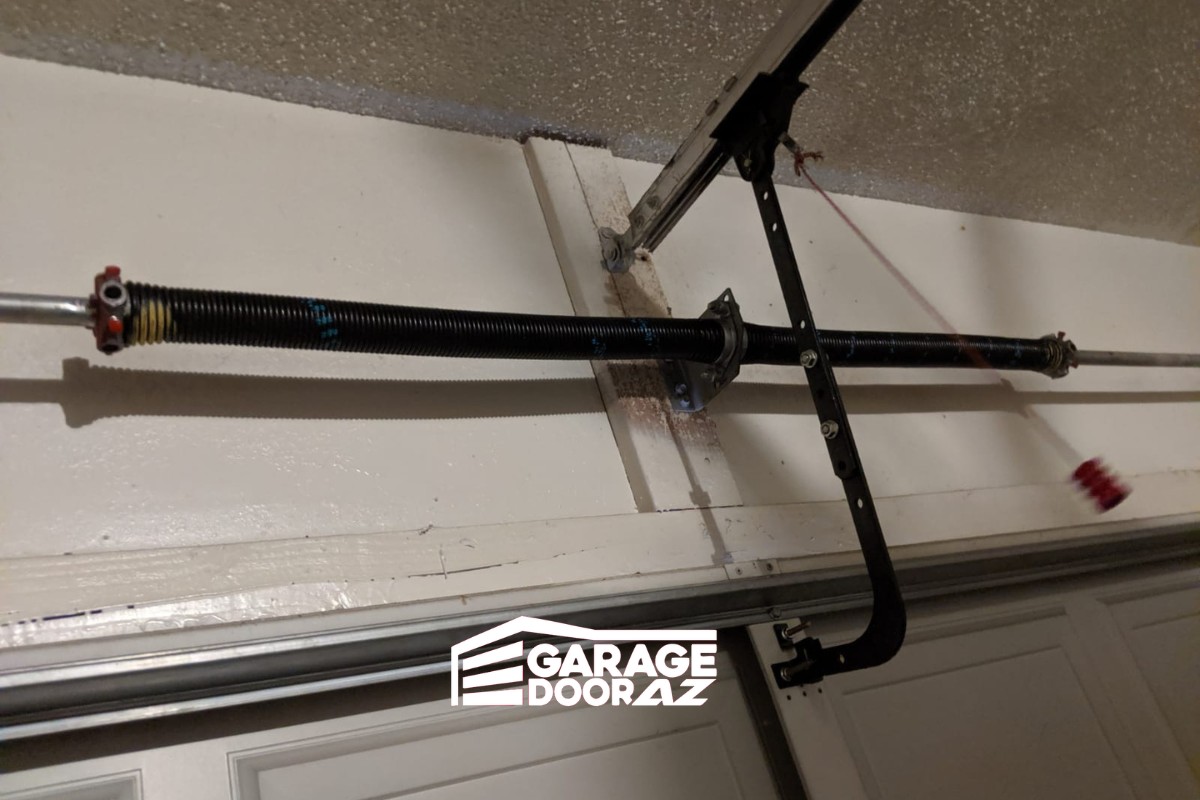
A broken garage door spring in Phoenix is the single most common reason a door stops moving entirely — not the opener, not the track. Torsion springs store hundreds of pounds of mechanical tension to counterbalance a 150–300 lb door, and Arizona’s extreme heat accelerates metal fatigue far beyond the national average. When a spring snaps, the garage door becomes dead weight, and no opener motor is rated to lift it alone.
Phoenix homeowners deal with this more often than most. Summer temperatures consistently reach 115°F+, causing the steel coils to expand and contract daily — a cycle that compounds stress on every wind of the spring. A spring rated for 10,000 cycles in a moderate climate may fail significantly sooner here. If you heard a loud bang from your garage — like a gunshot — and your door now refuses to move or hangs crooked, you almost certainly have a broken torsion spring.
Is Your Garage Door Spring Broken?
Identify your symptom below and know exactly what to do — before you call.
| Symptom | Probable Cause | Urgency | Recommended Action |
|---|---|---|---|
| Loud bang from garage Like a gunshot or snapping cable | Torsion or extension spring snapped under tension | 🔴 Emergency | Call for same-day service immediately. ⛔ Do NOT use the opener — door is unsafe to operate. |
| Door won’t open at all Opener runs but door stays down | Broken spring — opener can’t lift without spring tension | 🔴 Emergency | Call for emergency spring replacement. ⛔ Forcing it open can damage the opener motor. |
| Door opens 6–8 inches then stops Opener strains and reverses | Spring losing tension — partially failed or out of balance | 🟠 Urgent | Schedule inspection within 24–48 hours. ⛔ Continued use will burn out your opener. |
| Door looks crooked or uneven One side higher than the other | One spring broken or unequal tension (common with extension springs) | 🟠 Urgent | Replace both springs as a pair. ⛔ Replacing only one leads to repeat failure within months. |
| Door is very heavy to lift manually Much harder than normal | Spring tension weakened — end of service life or heat damage | 🟠 Urgent | Schedule spring replacement soon. ⛔ A balanced door should lift easily with two fingers. |
| Squeaking or grinding noise On every open or close | Dry or worn spring coils — lubrication depleted (common in Phoenix heat) | 🟢 Monitor | Apply silicone-based lubricant to spring coils. ⚠️ If noise persists after lubrication, book an inspection. |
| Visible gaps in the spring coil Spring looks stretched or separated | Broken torsion spring — coil separation is a definitive sign | 🟡 Schedule Soon | Book a replacement — spring is confirmed broken. ⛔ This is not a DIY repair. Springs are under extreme tension. |
Serving Phoenix, Scottsdale, Tempe, Mesa & surrounding areas · Licensed ROC 351695
Every job starts with a full inspection: spring type, drum condition, cable tension, and bearing plate wear. We explain exactly what we find before any work begins — no pressure, no upsells. Garage Door AZ LLC is licensed under ROC 351695, insured, and backs every spring replacement with a parts and labor warranty.
Why Phoenix Heat Destroys Garage Door Springs Faster
Torsion springs work by storing rotational energy in a coiled steel rod mounted horizontally above the door. Every time the door opens and closes, the spring winds and unwinds — one cycle. The problem in Phoenix isn’t just heat; it’s the thermal cycling.
Steel expands in heat and contracts at night. In Phoenix, the swing between a 115°F afternoon and a 75°F evening is roughly 40 degrees. That daily expansion and contraction creates micro-stress fractures inside the coil that accumulate invisibly until the spring snaps without warning. The fracture point is almost always near the stationary cone — the fixed end of the spring — where stress concentrates most.
The other Phoenix-specific factor is garage insulation. Many homes here have an attached garage that functions as a heat trap. Interior temperatures can exceed 130°F on summer afternoons, accelerating grease breakdown in the spring coils and increasing metal brittleness over time.
What this means practically: if your home has the original builder-grade springs — typically rated for 10,000 cycles with standard wire gauge — and the garage was built more than 5–7 years ago, those springs are operating on borrowed time in this climate.
Torsion vs. Extension Springs — What You Have and Why It Matters
Most Phoenix homes built after 1990 use a torsion spring system: one or two springs mounted on a steel shaft above the door opening, connected to cables that wrap around drums on each side. This system is more balanced, lasts longer, and is safer when it fails because the shaft contains the broken coil.
Older homes and lighter single-car doors sometimes use extension springs: two springs mounted horizontally along the upper tracks on each side, stretching and contracting as the door moves. These are cheaper to manufacture but more dangerous when they snap — a broken extension spring can fly across the garage at high velocity if the safety cable isn’t installed correctly.
Our residential garage door service covers both spring types. When you call, we’ll confirm which system you have and dispatch with the right hardware already on the truck.
Never attempt to remove or adjust a torsion spring yourself. The stored tension in a wound torsion spring is enough to cause serious injury or death if the winding bar slips. This is one of the few garage door repairs that requires a licensed professional — no exceptions.
What the Spring Replacement Process Looks Like
When a Garage Door Arizona technician arrives at your Phoenix home, the process follows a specific sequence designed to restore safe operation — not just swap parts.
First comes a full system inspection: spring type, coil count, wire diameter, drum condition, bearing plates, and cable integrity. Nothing gets replaced until we’ve confirmed exactly what failed and why. From there, the technician removes the broken spring using proper winding bars — never an impact driver or improvised tool — and installs the replacement high-cycle spring sized to your door’s weight and height.
After the spring is set, cables are re-tensioned and drums are realigned. A new spring only restores proper balance when the cable tension matches correctly on both sides. We then run a balance test — releasing the door at mid-point to confirm it holds position without drifting — and verify the opener’s force calibration settings, since a new spring changes the load the motor sees.
The full job takes 45–75 minutes for a standard residential torsion spring replacement. We carry parts for all major brands including Clopay, Amarr, Wayne Dalton, and CHI, so most jobs are completed in a single visit. If your garage door cables took damage when the spring failed — which happens frequently — we handle both repairs at the same appointment.
How Much Does Garage Door Spring Replacement Cost in Phoenix?
Pricing depends on spring type, wire gauge, cycle rating, and whether one or both springs need replacement. We provide upfront pricing before any work begins — you’ll know the full cost before the technician picks up a winding bar.
One important note on dual springs: if your door uses two torsion springs and one breaks, we recommend replacing both at the same time. The surviving spring has completed the same number of cycles as the broken one — it’s at equal risk of failure within weeks. Replacing both together saves a second service call and keeps the door balanced from day one. Call (480) 530-7131 and we’ll confirm availability and give you a quote over the phone before we dispatch.
For emergency garage door repair when the door is stuck open or blocking your vehicle, we prioritize same-day response across Phoenix. You can also contact us online to schedule a non-emergency inspection if the door is manually secured and the situation isn’t urgent.
The Right Call Before You Touch That Spring
A broken torsion spring isn’t a DIY repair — the stored mechanical energy in a wound spring is dangerous enough that professional replacement is the only safe path. This isn’t a sales pitch; it’s the same advice any licensed contractor in Arizona will give you.
The right next step is a same-day inspection. Our technician will confirm the spring type, check whether the cables and drums took any damage when the spring failed, and give you upfront pricing before touching anything.
Garage Door AZ LLC has been serving Phoenix homeowners under ROC license 351695 with licensed, insured technicians who explain every finding before work begins. We stock high-cycle springs designed for Arizona’s heat — not builder-grade hardware that fails in 4 years.
Call (480) 530-7131 to schedule. You can also visit our about page to learn more about how we operate, or browse our full services menu to see everything we cover on a single visit.